How NYC AI Startups Structure Their ML and Engineering Teams
How to structure ML teams as NYC AI startups scale from seed to Series B.

NYC AI startups typically grow from a lean generalist core at seed to embedded product teams at Series A and a shared-platform, hub-and-spoke structure at Series B+. For an ML engineer, Series A usually means making production systems reliable as teams work out who owns the product, while Series B offers a clearer sense of who owns what within shared systems. The best way to evaluate an offer is to establish who owns deployment, data pipelines, model performance, and model development.
Why NYC's AI startup scene is not a foundation-model ecosystem
Financial services is NYC’s largest employer of ML talent, and that demand shapes what startups compete to hire. Hedge funds, investment banks, and fintech companies need quantitative ML engineers, while media and advertising companies need recommendation systems, language processing, and real-time inference. Enterprise software companies in legal tech, real estate tech, and HR tech are embedding AI into their core products. Most of the work is applied, with less of it in frontier research. These businesses need teams that can turn models into dependable product features.
That changes both the hiring sequence and the meaning of seniority. A senior ML engineer at a fintech startup may need time-series modeling and alternative data analysis, while a healthtech counterpart needs clinical data pipelines and compliance-by-design. Those profiles are not interchangeable, even when the titles match. The same distinction applies to team design. A company building a clinical workflow has different staffing needs from one whose core product is a new model architecture.
The role distinction that matters most before any org chart — research scientist vs. ML engineer
An AI engineer turns existing models into a useful product, an ML engineer makes ML systems reliable and scalable, and a research scientist creates or validates new methods. As LLM work has expanded, research scientists, research engineers, applied scientists, and ML engineers have taken on overlapping responsibilities. People across these titles now work on distributed systems, large-scale training, and rigorous experimentation.
That overlap does not make the hiring distinction pointless. An applied startup can need someone who understands research deeply without needing a role centered on producing new research. But hiring only people with production experience can rule out researchers who have built truly new systems in universities or labs. Generalists are not automatically the better choice. The practical hiring rule is to hire for the current stage. Most Series A and B applied AI startups need a research engineer rather than a pure research scientist, unless research output is the core product.
What a seed-stage NYC AI team actually looks like and why it has to be lean
At seed, the team’s job is to prove that the product is useful. Founding engineers therefore need to move between software and ML work rather than optimize a narrow function whose inputs are still changing. The founding ML engineer needs to write production-grade code, handle MLOps, and make sure the system keeps working. There is little room for rigid handoffs. Original research moves up the priority list when it is central to the product, but that is the exception in NYC’s applied market.
A lean, centralized team keeps those builders close to the whole codebase. Decentralizing before that codebase is stable adds coordination work without a clear benefit. MorphoAI, a YC-backed NYC seed company with 7 employees, is building an AI-powered platform for engineers developing new robots and machines. Beacon Health, part of YC W26, is building AI employees for primary care, covering preventative screenings, prior authorizations, referrals, and risk adjustment for value-based care practices.
Compensation reflects the stage, with lower base pay than later-stage companies and meaningful equity. The structural risk, however, is having the wrong mix of skills. A team that over-indexes on model researchers and under-indexes on pipeline builders leaves ML specialists cleaning data, taking time away from refining models. During the foundation phase, the staffing balance should favor more data engineers relative to ML engineers.
Why MLOps is the load-bearing layer that seed teams almost always hire too late
That imbalance becomes a deployment problem as soon as the team needs models to work reliably in production. MLOps is the infrastructure that makes development viable at production scale, and postponing it creates technical debt that blocks the whole team. Without enough platform support, expensive specialists can be left waiting on one overloaded engineer.
Production MLOps work in 2026 includes deploying models on Kubernetes, configuring MLflow tracking, setting up automated retraining pipelines, and monitoring model performance. Those responsibilities support accuracy and availability over time. The staffing guideline is roughly one MLOps or platform engineer for every four to six people building models. That ratio is a planning rule. It makes the shared workload visible before every model builder depends on the same overstretched person.
In NYC’s healthtech market, this foundation also has to account for clinical data pipelines and compliance-by-design. Engineers need to own some of that work. Teams already scaling production ML can get more out of their data and run their systems more efficiently, while teams still working only in notebooks fall behind. This is why the seed-to-Series-A transition depends on more than hiring additional model specialists.
How Series A teams restructure around embedded squads and what breaks if they don't
Once customers use the product, repeatable deployment becomes a central engineering problem. Reliability, data pipelines, infrastructure, security, and evaluation take on greater weight than raw model capability. That creates a need for ML platform, data engineering, MLOps, and experienced backend talent. Series A companies start to form embedded squads that own specific features and use the infrastructure built during the seed stage.
The benefit is more focused product development, but it comes with a condition. Shared MLOps needs to exist before model development spreads across teams. Otherwise, each team can develop a bespoke pipeline, leaving the company with systems it cannot maintain at scale. This is the fragile part of the transition. An embedded ML role can give the engineer a clear feature to own while still leaving them to deal with gaps in the company’s infrastructure.
Hebbia’s Matrix illustrates the product demands behind that shift in finance and legal AI. Hebbia describes a workspace where analysts upload thousands of documents and receive structured, citation-linked outputs in a data grid, with documents as rows and questions as columns. That is a product workflow. Its mix of ML engineers, software engineers, and AI researchers fits work on both models and a complex document-processing pipeline.
Leadership and hiring processes also start to change. The right time for a senior leader is when coordination, hiring, and strategic ownership constrain founders or existing technical leads. Early leaders may still need to be deeply hands-on. Research-engineer base pay rises from seed levels, with equity still central to the offer. Interviews become more production-focused too, using problems such as diagnosing a meaningful drop in a recommender’s click-through rate and reducing reliance on LeetCode.
What the Series B+ federated hub-and-spoke model looks like in practice across NYC verticals
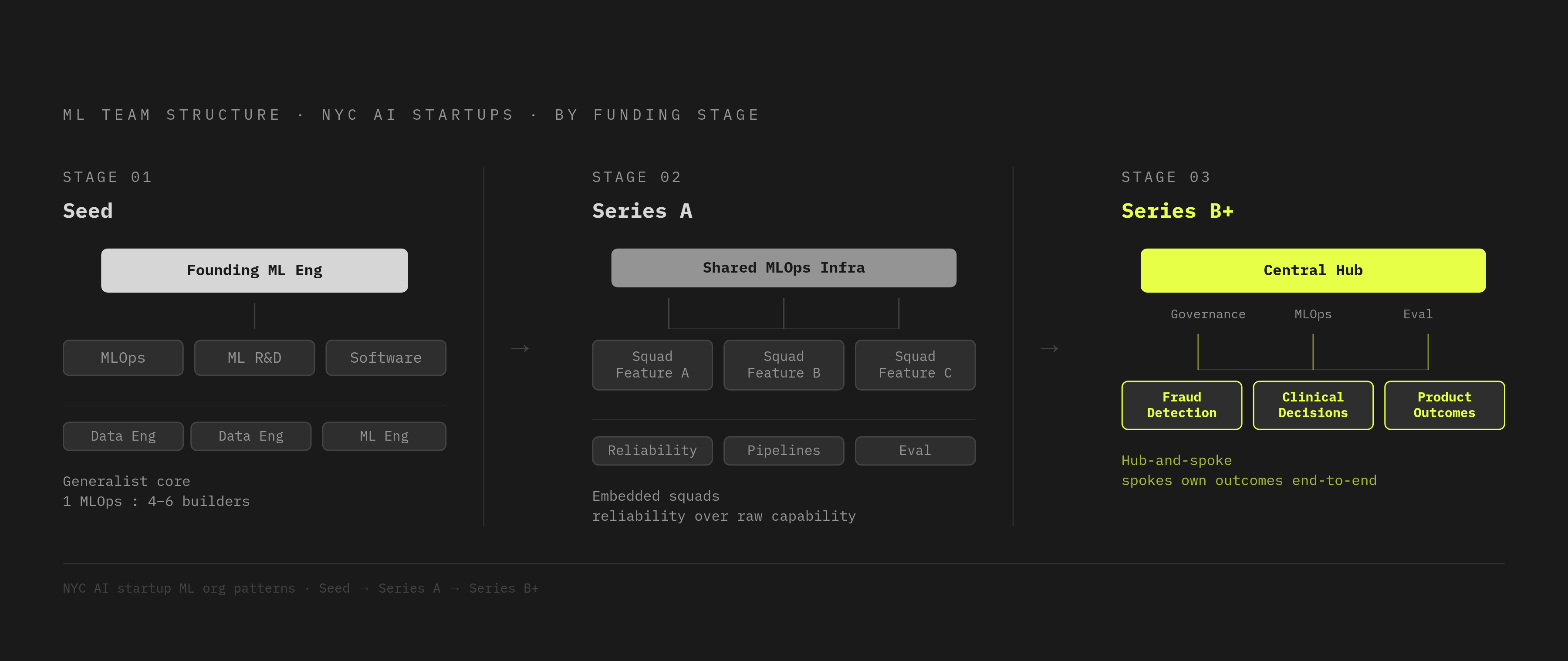
At Series B and beyond, the dominant structure is a federated hub-and-spoke model. A central hub owns model governance, shared MLOps infrastructure, evaluation frameworks, and platform tooling, while embedded engineers own specific product outcomes. A fintech spoke might own a fraud detection pipeline end-to-end, while a healthtech spoke might own clinical decision support for a particular care pathway. The hub keeps those teams from rebuilding incompatible foundations.
EliseAI’s work spans leasing inquiries and maintenance requests in property management, as well as appointment scheduling, intake forms, and reduced waiting time in healthcare. Those are distinct workflows, even though both use conversational AI. These products show why teams that know their own domain can work well with shared technical systems. They do not, by themselves, establish the company’s internal reporting lines.
Research-heavy work complicates the picture without overturning it. Runway’s official careers page lists Engineering and Research as separate departments, illustrating that a later-stage company can retain both kinds of work rather than folding everything into applied engineering. That distinction is useful when interpreting a role. A department’s name alone cannot tell an engineer whether they will own research methods, shared infrastructure, or a product outcome. A company’s stage alone also cannot prove how its teams are set up.
As embedded teams take on agentic workflows, their responsibilities can extend beyond model endpoints to agent orchestration and tool use. The hub-and-spoke split still holds, but the product team has more to own. For an engineer, that makes the scope of ownership important. A posting centered on model performance may describe a different job from one centered on an entire workflow, even within the same company.
Pay also varies across NYC’s hiring markets. Quantitative finance, media and recommendation systems, and enterprise applied AI compete for different combinations of expertise. At this stage, hiring speed becomes a structural constraint too. Senior AI and ML roles can take many weeks to fill, and staff roles take longer, while strong candidates quickly move on from hiring processes that are still open. The interview process therefore exposes not only the technical bar but also whether the company can make a timely decision.
What should an ML engineer look for in a Series A versus Series B startup job?
A Series A posting should be read for how much production structure the engineer will help build, while a Series B posting should be read for the boundary between product ownership and shared-platform support. At Series A, an engineer who works on specific features may also have much of the work of making deployments repeatable. At Series B, a more defined role may depend on a central team for tooling, evaluation, and infrastructure. Neither label guarantees that the supporting systems are mature.
The language of the posting provides the first clues. A mix of ML and software engineering, “founding engineer” or “0 to 1,” and responsibilities spanning models, infrastructure, and product point toward a seed-style generalist role. Explicit equity discussion often accompanies that breadth. By contrast, a named product surface or vertical, references to shared infrastructure, and collaboration with a central ML platform team point toward a hub-and-spoke role. Posted compensation bands can help frame the offer, but they do not explain the ownership split.
Founding roles at NYC AI startups skew toward full in-person presence, and EliseAI’s four-to-five-day-per-week requirement is a concrete example of the on-site expectations candidates can encounter. Attendance is part of the offer’s scope. It belongs in the evaluation with base pay, equity, and technical responsibility rather than being treated as a detail to resolve after the interviews.
To test the posting’s promises, the first recruiter conversation should establish who owns MLOps, how many models are in production, and what the retraining cadence looks like. These questions show how the work is set up faster than an org chart does. Who owns MLOps, the hub or the product team, suggests where the engineer’s responsibilities start and end. The production model count and retraining cadence add context about the work already running. An offer becomes easier to judge when it is clear whether the engineer is joining to build the foundation, own a product on top of it, or maintain the shared platform itself.