Why NYC AI Founders Who Post Salaries Upfront Close Engineers Faster Than Those Who Don't
Transparent salary ranges help NYC AI startups hire engineers faster.

NYC AI founders hire engineers faster when they post a salary range engineers can judge, explain equity and how they expect people to work upfront, and make clear how long interviews will take. Salary disclosure removes an early filtering step and reduces the chance of discovering a pay mismatch at the offer stage. An honest posting earns attention, but a fast hiring loop turns that attention into a signed offer.
Why NYC's salary transparency law creates a real compliance floor — and why most founders still leave room above it
NYC's Local Law 32 took effect on November 1, 2022. It requires most employers with four or more employees to include a good-faith salary range in postings for positions that can or will be performed in New York City. For a covered AI startup, the decision is therefore not whether salary belongs in the posting. The published range needs to give an engineer enough information to decide if the role fits.
First offenses carry no civil penalty if cured within a short window after a complaint, while uncured first violations and subsequent violations face substantial penalties. Repeated violations bring escalating exposure. Enforcement has pursued complaints involving as few as two non-compliant postings, and one complaint challenged whether an unusually wide range could count as a good-faith estimate.
Yet a meaningful share of postings covered by pay transparency laws still omit salary information. NYC's Local Law 144 offers a cautionary parallel. That law requires algorithmic bias audits for hiring tools, but only a small fraction of employers posted required audit reports after enforcement began. The New York State Comptroller's December 2, 2025 audit found that DCWP received just two complaints during July 2023–June 2025. Few complaints do not prove that most employers follow the law. For candidates, a founder's willingness to disclose useful information beyond the minimum is a more direct signal of seriousness than the mere absence of an enforcement problem.
How NYC AI compensation is structured and what a usable salary range actually needs to include
RFS's 2026 hiring guide puts NYC AI startup compensation only modestly below San Francisco, reflecting a materially narrower cash gap than before. Location alone no longer tells an engineer much about the offer. Neither does the title. The NYC AI talent pool spans frontier labs, fintech quant shops, scale-up AI-product companies, and seed-stage startups, each with different compensation structures. A posting that says “ML engineer” without stating pay leaves the candidate guessing which market the employer belongs to.
The NYC ML market has a strongly bimodal pay distribution, with a thin middle that an average can obscure. Engineers with the credentials to choose among employers tend to target specific tiers. They use a salary range to identify whether a role sits in the part of the market they are considering. Without it, a familiar title can conceal a substantial mismatch in cash expectations.
Level can leave engineers unsure about pay within those tiers, too. A mid-level software engineer, a senior software engineer, a staff engineer, and a senior ML engineer are not interchangeable hires. A usable posting connects the role's scope to a defined base range, rather than asking candidates to infer pay from seniority or the company's funding stage. That gives the engineer something concrete to compare.
Equity belongs in that comparison as well. A meaningful share of New York ML engineer postings include equity with base pay, so founders who leave it out disclose less than some of the alternatives candidates already see. Base salary answers only part of the question. An engineer evaluating startup compensation also needs to understand the ownership component, especially when comparing a seed-stage company with an established employer. If cash and equity are both unclear, the candidate has to start a conversation to decide whether the role could work.
Why engineers filter on salary range before they read anything else in a posting
Senior engineers with options increasingly treat salary as a baseline filter, much like work model or tech stack. “Competitive salary” does not help them apply that filter. Nor does “commensurate with experience.” Those phrases make the candidate spend time asking about pay the founder could have shared before they spoke. For an engineer already weighing several opportunities, that uncertainty can be enough to remove the role from consideration.
An opaque posting does not merely produce a slower version of the same hiring process. It can produce a smaller consideration set, because some qualified engineers never engage at all. That makes the cost easy to miss when reviewing a pipeline. The founder's view is limited to the people who applied.
Work model compounds the same problem. Engineers filter roles by both salary and where they will work, and NYC seed-stage AI startups are overwhelmingly in-office. A posting that explains both in its first paragraph removes two common reasons for an early exit. It also lets a candidate rule out the role before anyone spends time on an interview. Someone who needs a different work arrangement is not a stronger prospect simply because that conflict stays hidden through the first call.
RFS identifies JPMorgan AI Research and Bloomberg Technology as the most common competing offers for NYC AI startup candidates, with Two Sigma and Citadel also competing for those engineers. A startup withholding its range asks candidates to compare an unknown with institutional alternatives whose compensation they may already understand. The objection that disclosure attracts people who only want to negotiate misses the direction of self-selection. Engineers who reject the published pay would otherwise be likely to reject it later, while those who engage have already cleared an important condition. That changes where the hiring clock starts.
How do you hire engineers quickly without leaving salary negotiation until the end?
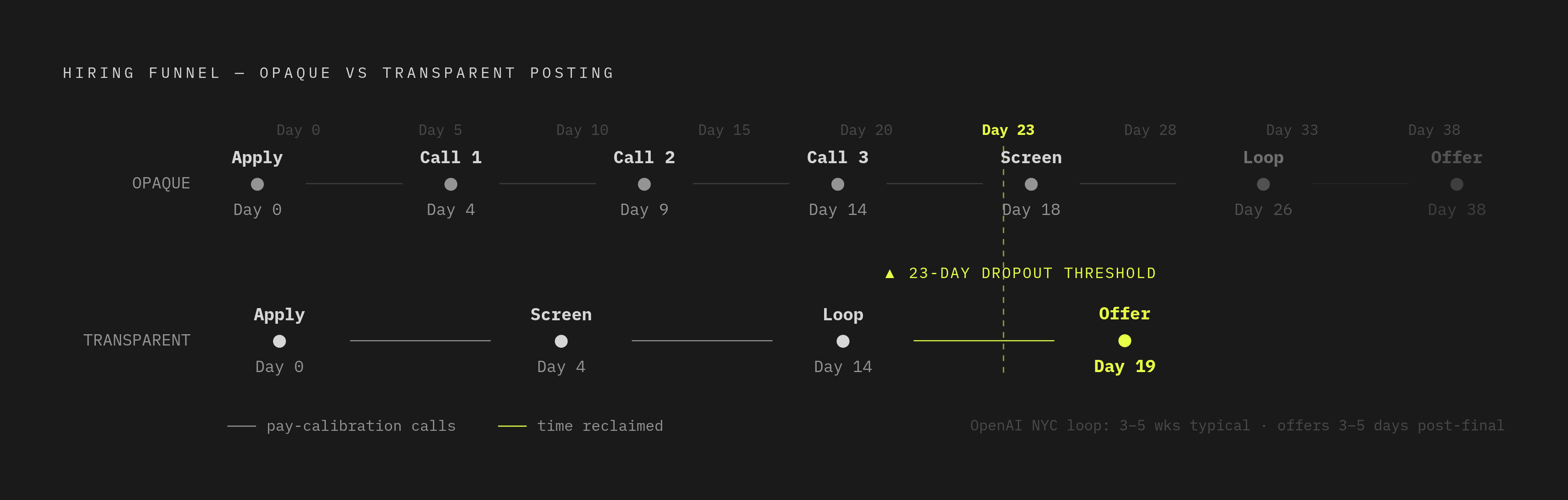
Posting a real range can eliminate the first two or three recruiter calls typically spent calibrating pay expectations. Those calls take up meeting time and add days to the hiring process. Putting basic pay details in the posting lets both sides spend the first conversation on the role, with a sense of whether the pay could work for them. It removes the avoidable surprise that the candidate and founder were discussing entirely different compensation levels.
The gain also reaches the sourcing stage. Mandatory salary disclosure is associated with materially more applications than optional disclosure, which can give a founder a larger pool of candidates who already know the pay. More inbound interest alone is not the goal. The useful change is less time spent sourcing people who will later discover that the range does not work for them. Listed salaries are also associated with lower ghosting, with a straightforward mechanism in the notes' argument. Candidates have fewer unresolved pay questions that can cause them to disengage between conversations.
That saved time has value in a narrow window. In this market, a slow, multi-round process can lose candidates at the 23-day mark, even when the original posting was clear. OpenAI's NYC interview loop offers a point of comparison, taking 3–5 weeks for typical candidates and 2–3 weeks for urgent or highly competitive cases. Offers typically follow within 3–5 business days of the final round, sometimes taking up to one week. A founder does not need to copy that process to face its competitive pressure. Each discovery call that could be skipped gives another employer more time to decide.
RFS reports that NYC AI startup roles close faster than the national average and that an ownership story with a clear Series B → IPO/acquisition timeline does the most to get candidates to accept. That is the company's growth story, distinct from the interview schedule the candidate also needs to understand. Clear pay gets the engineer interested enough to hear it. Transparency can reduce employer negotiating room, and research finds modest wage increases after mandatory posting, without changes in employment levels, posting volume, or skill requirements. For a seed-stage founder whose main constraint is closing engineers rather than limiting every wage increase, that is a bounded cost against a concrete recruiting advantage.
What a well-structured NYC AI posting actually looks like — and what a wide or vague range signals instead
A posting should put a defined base band, an equity band, and the work model where candidates can find them immediately. An AI legaltech founding engineer role posted in December 2025 used that format, pairing salary and equity ranges with an on-site requirement in Brooklyn. The location detail was part of the compensation decision. Together, those disclosures gave engineers the information needed for a first-pass decision in under two minutes. The format worked by making the role comparable before asking for an application.
A performatively wide range defeats that purpose. The candidate still has to ask which part of the band applies and what separates one end from the other. That recreates the calibration step disclosure was supposed to remove. It can also create legal exposure if the range is challenged as something other than a good-faith estimate.
The distinction is between a range and a useful range. Tight, honest bands help people decide whether to apply, bringing in better-fit candidates who are more likely to accept an offer while cutting down on calls just to learn the pay. A vague band keeps the central uncertainty intact. The same is true of listing base pay while referring to equity without defining its range.
HubSpot shares compensation ranges on each job posting across the U.S., so people outside the company can see them too. Founders can do the same by sharing and sticking to an approach to pay that makes each posted band believable. A candidate should not have to guess whether the numbers express an actual hiring budget or an opening position with no clear boundaries. Clear interview timing then gives that credible offer a process the engineer can evaluate as well.
Where to find the engineers for whom salary transparency is table stakes, and how the matching process works
The engineers most responsive to pay transparency are also the ones most likely to leave an opaque process early. Senior engineers who are weighing several roles judge how serious a founder is by how clear the information is. They have alternatives and limited time. A clear posting therefore helps most when it reaches people for whom both the role and the compensation tier are plausible.
RFS identifies financial AI alumni from Two Sigma, Citadel, and Bloomberg as a productive, underserved source for startups seeking engineers who want to build products. It also points to healthcare AI alumni from Flatiron Health and Health Catalyst who are ready for earlier-stage work. These are different talent pools with different reasons to move. Their usefulness comes from the match between prior work and the startup opportunity. Sharing pay upfront lets those engineers see whether they could afford the move before they hear the ownership story.
Community and university channels serve other parts of the search. RFS names the NYCAI meetup, AI Camp NYC, and MLOps Community events, together with Columbia, NYU, and Cornell Tech pipelines for engineers who want to stay in NYC. The channel still has to fit the tier. Seed-stage AI startups hire almost entirely through people the founders know, warm introductions, and matched referrals, with little reliance on generic applications finding their way to a six-person company. In that setting, matching means connecting a relevant engineer with a role whose pay, ownership, and work expectations are already legible.
The referral is only the start of the process. A founder who publishes an honest range but then runs a slow loop can still lose the candidate within that 23-day window. Salary transparency and timeline transparency solve different uncertainties, so one cannot stand in for the other. The first establishes whether an offer could work, while the second shows how the company plans to reach it.