Why the Platform You Choose to Find ML Talent Determines Which Engineers Ever Hear About Your Startup
Job boards, vetted networks, and global pools each reach different ML engineers.

Choosing a platform to find ML talent means choosing which engineers ever hear about your startup. Startup boards reach people who are looking for jobs, vetted networks reach candidates who have been pre-screened, and research channels reach specialists whose work may never appear on a hiring site. The best channel depends on the job, the company’s stage, and whether the right engineer is looking at all.
Why the ML hiring market is so thin at the top
A founding team posts an ML role and gets flooded with applicants whose main evidence is that they have fine-tuned a chatbot. The gap is between familiarity with models and proof of shipping something that works. For a founding hire, that proof has to include taking a product from nothing to something customers can use.
The shortage is concentrated at the experienced end. Engineers with that shipping record are on the same shortlists at well-funded AI companies, while strong candidates are reachable through only a small number of channels. They are not all on the same ones. Speed narrows the opening further because candidates with multiple offers leave open processes quickly. A startup can lose access by searching in the wrong place or by taking too long once it finds someone.
Why the platform decision is really a population decision
A hiring platform filters people before a recruiter does. Engineers choose where to spend their time based on the work they want, their interest in changing jobs, and the process they expect. Those choices change both who applies and how many people apply. A bigger pool is not necessarily a better match.
Consider a startup-native board such as Wellfound. An engineer there has already expressed interest in startup risk and equity, so the selection is motivational as well as technical. That is different from reaching a passive researcher through a publication record or a freelancer through a project marketplace.
Even the title becomes part of the filter. A research scientist posting shown to people who work in product-engineering can miss the people it is meant to reach before screening begins. Conversely, a broad “AI engineer” title does little to identify a role that requires original research. Once platforms are understood as population filters, the useful question changes. Which population matches the work the startup actually needs done?
The three ML role types that need to be separated before any platform is chosen
An AI engineer turns existing models into a useful product. An ML engineer makes machine-learning systems reliable and scalable. A research scientist creates or validates new methods. These are different jobs, even when their tools overlap. A posting that combines research, product development, and MLOps into one undifferentiated role will struggle to reach any of those populations cleanly.
At frontier companies, however, the boundaries are less stable. Anthropic says that “engineers here do lots of research, and researchers do lots of engineering,” describing a boundary that has dissolved with the advent of large models. That does not mean every startup needs a scientist. Most Series A/B AI startups need a research engineer rather than a pure research scientist unless research output is the product.
The hiring sequence also changes with the business. A seed company using third-party models may begin with strong product engineers, then add ML ownership for evaluation infrastructure, fine-tuning, serving, or data quality as usage grows. Evaluation becomes more important once customers use the model. Likewise, a remote research scientist search is not interchangeable with a remote ML engineering search, because remote availability differs substantially between those role types.
What startup-native job boards actually surface and when they are the right starting point
Startup-native boards reach engineers who are already open to working at a startup. They are considering risk and equity, rather than needing to be persuaded to consider that kind of employer in the first place. That makes them more likely to respond than passive candidates reached through cold outreach elsewhere. It does not establish technical ability.
Wellfound represents this motivated inbound population, but the hiring company still has to screen it. Dover addresses a related constraint through a free ATS combined with on-demand fractional recruiters. The distinction is useful for a lean team. Sometimes the bottleneck is not finding more applicants but having enough recruiting capacity to handle them.
These channels fit product ML roles at seed-to-Series-B companies with in-house screening capacity. Their limit is the actively looking population. People at top AI companies who are not looking for work rarely apply through standard postings, so searches for a founding engineer rely heavily on direct outreach. A board can be a sensible starting point for an AI engineer, ML engineer, or MLOps hire without being the right primary channel for the first technical hire or a research scientist.
Where AI startups find pre-vetted ML engineers and what matching networks cost the hiring team
Vetted networks do some of the screening work for the company. That can shorten the path to a qualified candidate, but it also means the network’s admission criteria define the initial pool. The hiring team gains speed while giving up some control over that first filter. Vetting is not a single, uniform standard.
Toptal fits projects with a clear deliverable and end date. Arc.dev offers vetted candidates for freelance and full-time work, while Andela embeds engineers from trained cohorts. These are different engagement models. A project specialist can solve a problem with a clear scope, while a long-term employee takes care of the system with its past and future in mind.
Commercial terms create another distinction. Gun.io says that developers’ profiles show the full price upfront, while full-time salaried placements use a placement fee. Andela quotes pricing after a discovery call. Arc’s contract-to-hire fees are not published upfront, so the recommended check is before a trial becomes a job offer. Braintrust also offers a vetted marketplace, but fee terms identified as being from 2023 should not be treated as an undated promise.
Matching claims need the same care as pricing. Published turnaround times are platform claims that lack independent verification as benchmarks. For founding searches, Paraform can reach a different group of people through its access to frontier-lab alumni. For a growth-stage company that needs someone to own ML for the long term, though, ongoing fees and the company knowledge lost in freelance arrangements can make a direct hire a better fit.
What global talent networks surface and when time zone and cost structure change the platform calculus
A global search starts with two questions. Does the engineer’s experience fit the work, and does the available time zone overlap fit the collaboration? For LLM, retrieval, and agent development, a full-time engineer can work effectively with partial overlap. When a research scientist works closely with a small founding team, a large time difference makes it harder to work together.
Second Talent places AI-native senior engineers from ten Asian markets and screens them with a live Claude Code pull request in a real codebase. Its bench covers LangChain, LlamaIndex, Hugging Face, PyTorch, vector databases, and agent frameworks including LangGraph and CrewAI. Engineers maintain four to six hours of overlap with the US working day. That is partial overlap.
Latin America offers a different geographic fit. Brazil has the region’s largest developer population, Argentina has strong data science depth, and Mexico offers the closest time zone alignment with US teams. Colombia has invested heavily in tech education. Revelo focuses on vetted engineers across Latin America, rather than serving as an undifferentiated worldwide network.
Regional compensation and labor compliance affect the decision, but they come after the skills match. Global hiring gives the company access to more engineers whose experience may be a better fit for the role. The category also needs care because talent for AI training work is not the same population as engineers who build and own product ML systems.
What research-network sourcing surfaces and why most recruiting teams never use it
Research specialists can be identifiable through their work before they are identifiable as candidates. arXiv authorship, NeurIPS and ICML contributor lists, and workshop rosters expose evidence directly related to research-heavy roles. Hugging Face Hub adds public model releases and dataset contributions. These records function as portfolios independently of job-seeking intent.
The outreach has to reflect that distinction. A specialist who ignores a generic recruiting message may respond to one that shows familiarity with their published work. Finding that connection takes effort. Reading papers, finding out who contributed what, and writing messages that show knowledge of the work take time that many small recruiting teams cannot spare.
This is a narrow channel with a specific purpose. For foundation model companies, research-output-core startups, and roles that genuinely require familiarity with the literature, it can reach a population with no other reliable route into a hiring process. Its value comes from the research evidence it exposes, with limited applicability for a startup assembling a product from existing models.
How the channel chosen shapes the interview loop the right candidate will accept
A candidate who has passed a vetted network’s screen expects a process consistent with that signal. A freelancer considering a scoped project may expect something much lighter.
For product AI roles, work-based assessment can connect the interview to the job. Relevant formats include a walkthrough of a shipped AI feature, a paid RAG or agent-app take-home with an eval set, and a live extension that reruns those evals. System design can focus on cost and latency. A pair session with an AI coding agent tests another part of how the candidate would work on the job.
For remote ML roles, the practical recommendation is to skip algorithmic coding puzzles unless algorithmic complexity is genuinely part of daily work. A realistic problem, such as routing labeled support tickets to the right team, gives the candidate room to explain an approach. Respect for time is equally important. An unpaid six-hour take-home can drive away senior candidates, especially those found through technical communities that care strongly about hiring hygiene.
Rigour and delay are not the same thing. Frontier-lab alumni reached through Paraform may expect a tough loop that respects their time, while the same process could be too much for a short job through Upwork. A slow, generic process can undo good sourcing. Teams that close strong ML hires design the loop for the population they reached.
How to match platform choice to the ML role type and company stage you are actually at
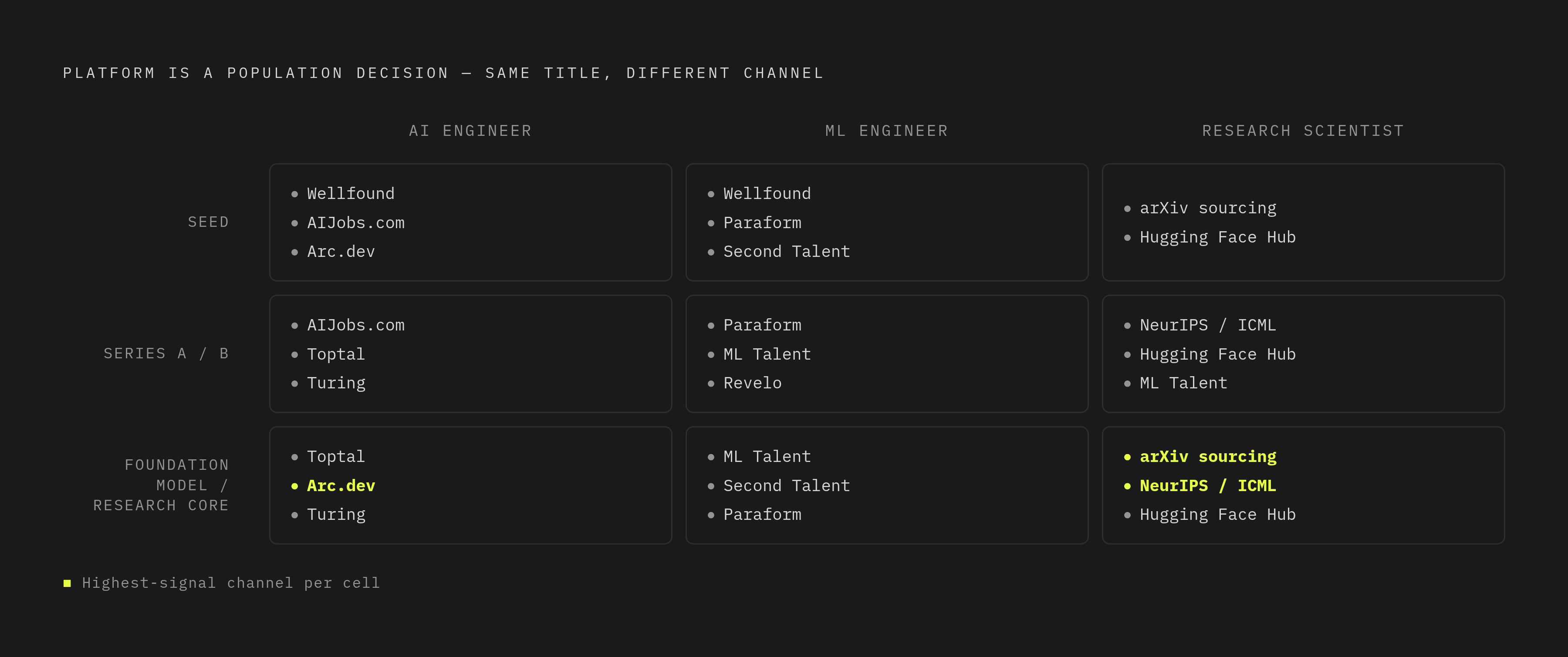
For a seed-stage product ML hire, startup-native boards such as Wellfound and AIJobs.com are a useful starting point for motivated inbound. A vetted network can supplement them when speed is important. Research-network sourcing belongs in that mix only when the role has genuine research requirements. The job’s work, rather than its AI label, determines the channel.
The target population is often passive, so direct outreach through Paraform or personal networks takes priority over waiting for applications. ML Talent is another option for funded US and Canadian startups seeking senior AI engineers in their time zone, with the option to begin with a dedicated engineer before committing to a full-time hire. That model addresses a different decision from buying a short freelance project.
At Series A/B, research-adjacent engineering calls for publication and contribution sourcing, targeted outreach, and potentially Paraform for frontier-lab alumni. The sourcing timeline is longer. Scale-out work in MLOps, evaluation infrastructure, fine-tuning, and serving opens a different route through Turing, Second Talent, or Revelo when overlap is workable. Arc.dev and Toptal fit the parts of that work that have a clear scope.
For a foundation model or research-output-core startup, research-network sourcing becomes the primary channel, complemented by direct conference-contributor outreach and Paraform. Boards may generate applications without producing the required research signal. Titles must reinforce that choice. Calling a research role “AI engineer,” or placing a research scientist posting before a product-engineering audience, weakens the filter.
Curated talent marketplaces for AI startup hiring occupy a further position between broad boards and freelance networks. Upfront salary bids and compressed timelines serve engineers selectively open to a next startup role. For a buyer comparing marketplaces, the decisive criteria are the population reached, the work the screening tests, the employment model, and the expected hiring pace. A platform’s claim to offer elite talent is less useful than evidence that it reaches the kind of engineer the startup needs.