Inside the NYC ML Hiring Networks That Surface Equity Terms Before the First Recruiter Call
NYC's pay law skips equity, but ML engineers can still find it.

For ML engineers weighing Series A and Series B AI startup jobs in NYC, salary is only the visible part of the offer. Equity grants shrink as companies grow, so comparing them takes ownership, valuation and stage as well as a share count. NYC’s salary disclosure rules leave that information out, but engineers can learn it through hiring networks before the first recruiter call.
Why NYC's pay transparency law leaves equity out, and what that gap means for ML engineers
New York Labor Law Section 194-B requires employers with four or more employees to post good-faith salary or hourly compensation ranges. The NYC city law explicitly requires a base-pay range and leaves disclosure of bonuses, equity and benefits optional. Employers can describe equity separately, but they do not have to supply the terms that make a grant assessable. That leaves a large hole for ML engineers. City Council legislation, Introduction 808, would have required disclosure of non-salary compensation, including options and equity, and allowed current employees to request the full compensation range for their position. It was filed at the end of the legislative session without passing. A posted salary range can tell an engineer whether the cash is enough, but it says nothing about how much ownership comes with taking startup risk.
Why equity — not base — is the actual decision variable for NYC ML engineers right now
NYC’s quant firms offer ML engineers more cash than most AI startups can pay. That alternative changes the meaning of a startup offer. Equity is the part of compensation meant to justify giving up cash for an uncertain outcome. As NYC and Bay Area cash compensation converge for equivalent senior roles, geography becomes less useful for explaining why offers differ. The grant itself needs to withstand scrutiny.
This is sharpest at seed-stage companies, where base pay sits toward the lower end and equity does much of the work. Those companies also recruit mainly through Twitter/X, founder mutuals, former coworkers and matched introductions. The job and its missing compensation context travel together. An engineer may hear that a founder is hiring, learn the broad equity posture and decide whether to pursue an introduction before a recruiter is involved.
The same economic question follows engineers into Series A and Series B opportunities, although the reference points change. A first hire’s grant is not the benchmark for every later employee, and pre-seed ownership is not the benchmark for a company that has raised several rounds. Without that context, a candidate can mistake a large share count for a generous offer or pass over a smaller grant without knowing how much ownership it gives them.
The four NYC ML sub-economies and how equity culture differs across them
Frontier AI labs are one distinct market. Anthropic, OpenAI, Google DeepMind and Meta FAIR have NYC presences, with hiring running through referrals, internal moves and a narrow inbound channel. Equity supplements an already high base salary. In this tier, the relevant network is connected to lab hiring rather than to founders seeking their first technical employee.
Quant fintech operates on a different bargain entirely. Two Sigma, Citadel, Jane Street, D.E. Shaw and Hudson River Trading offer an all-cash structure rather than equity, with the partner track as the longer-run bet. Technical recruiter outreach leads into rigorous, multi-round assessments anchored on probability and applied ML. Here, startup equity benchmarks do not explain the offer. Engineers can use that cash package to judge offers elsewhere.
Scale-up AI-product companies at Series B–D hire engineers to take charge of retrieval, ranking, evals, fine-tuning and the data infrastructure around them. Senior hiring is often founder-led, while mid-level hiring is recruiter-led. Pre-IPO equity distinguishes these jobs from quant cash. Seed-stage startups, by contrast, may be hiring their first or second ML engineer, with equity as the main compensation lever and warm networks as the main route in. A job-board application does not match how that early market principally hires.
Job titles add another layer of confusion. ML engineers who ship production systems, research scientists who develop new methods and AI engineers who turn existing models into products differ in how they get hired and what equity they expect. Quant ML, NLP/LLM, applied data science and recommendation roles also need different sourcing. The useful comparison therefore pairs the “ML engineer” role with company stage.
Where equity terms actually circulate before any formal process begins
Thousands of people who work in the field come to The AI Summit New York, including CTOs, VPs of AI and founders. That seniority mix makes it a venue for signals about senior individual-contributor and leadership hiring. A conversation about a scale-up’s senior ML opening belongs to a different compensation context from a founder’s search for a first engineer.
For seed-stage jobs, engineers are closer to the hiring through Twitter/X communities of AI practitioners, people who know the founders and talks with former coworkers. The introduction can arrive with context already attached. A candidate may learn the company’s stage, the kind of engineer it needs and how its grant compares with other early hires before deciding whether to speak to the founder. That is the practical advantage over finding a salary-only posting.
The AI Engineer NYC conference is another venue when it runs. For seed-stage and Series A candidates, these are places where founding-team equity discussions happen outside a formal application process. They also give engineers without a shared employer a place to enter the conversation. Attendance is not the same as access to every company’s terms, but prior lab or startup affiliation is not required to show up.
These channels also fit the senior candidate market. Only a small share of senior NYC ML candidates are active on job boards. The larger pool is employed and moves through trusted introductions. Equity information follows those same paths. For someone who is not actively applying, an informed introduction can establish whether a startup is worth considering at all.
How do you evaluate an ML engineering offer from a Series A versus Series B AI startup?
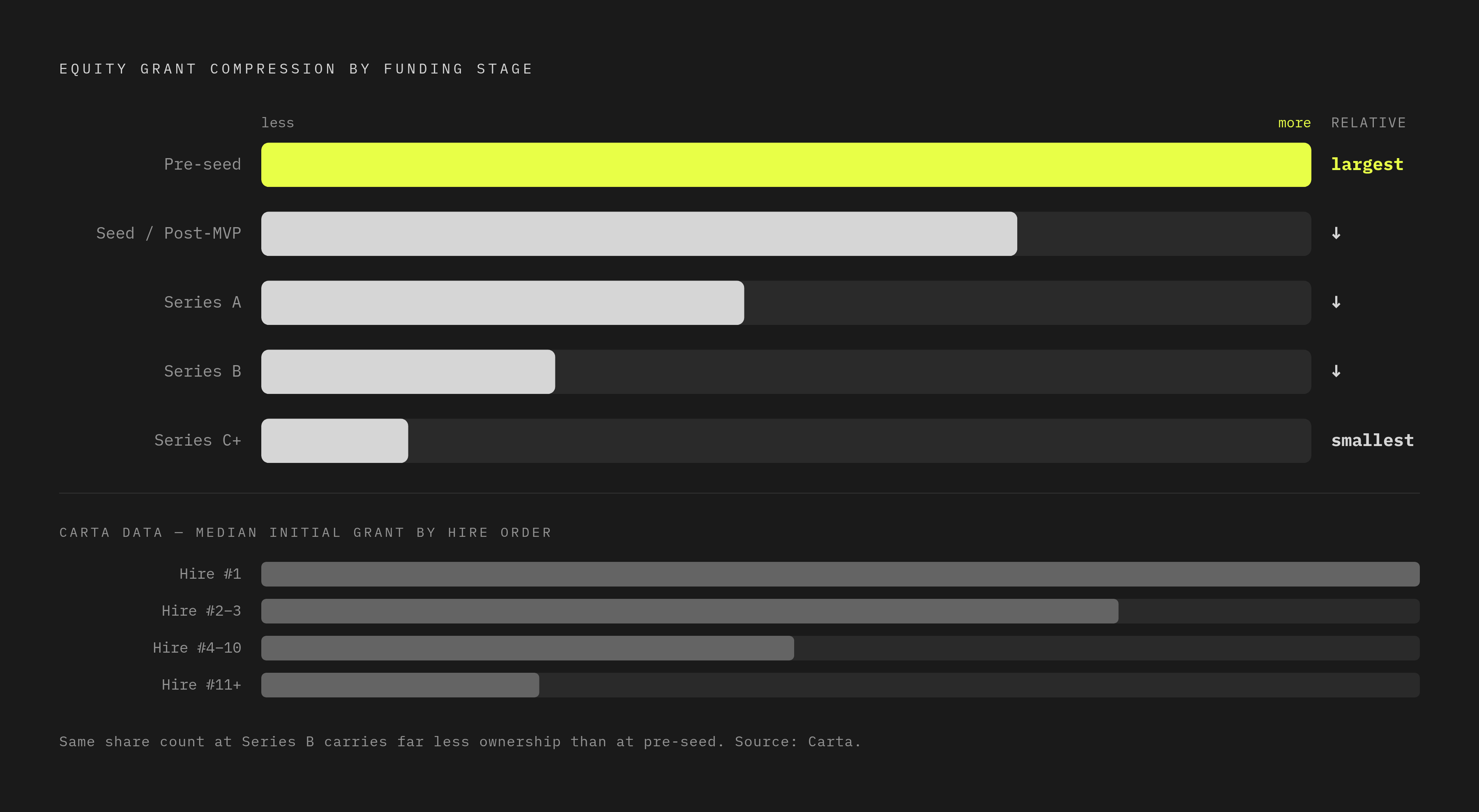
The useful equity discussion starts with five data points, namely shares offered, strike price, total fully diluted shares outstanding, the latest 409A valuation and the last funding round valuation. A share count alone is not enough. Shares offered divided by fully diluted shares establishes the ownership percentage, while the price and valuation information provide context for assessing the grant’s rough value. Together, these figures make different offers more comparable. What the grant might pay out in the future is still uncertain.
Stage then changes the reference frame. Post-MVP or seed grants compress from pre-seed levels, Series A grants compress further into a narrower band, and Series B grants shrink again relative to early-stage norms. Series C and later grants are smaller still against founding-stage benchmarks. Series A versus Series B is therefore not simply a contest over who offers more shares. The comparison needs to account for how much ownership is offered at each stage and how heavily that ownership should be discounted for risk.
Carta’s analyzed initial equity grants provide another baseline, with median initial equity tapering from hire #1 through subsequent early hires. Hiring order changes the comparison too. Peer conversations use these benchmarks to pressure-test whether an offer fits the stage and position in the hiring sequence.
For an engineer evaluating an offer, the lesson is to request the five figures and compare the grant with the right stage and hiring-order benchmark. The engineer must then assess whether the job is worth taking if the options expire worthless. The discount logic used in these networks treats pre-seed equity more heavily than Series B equity because most startup equity is worth zero.
These networks also share hiring intelligence about which companies are actively hiring, what assessments look like, which founders seem worth the equity risk and which Series A or Series B companies may raise again. Those signals can change the appeal of a low-base, high-equity offer without establishing its future value. For scale-up roles, the work itself (retrieval, ranking, evals, fine-tuning or data infrastructure) also belongs in the decision, especially under the worthless-options test.
The access problem: who these networks reach and who they still miss
The strongest objection is that trusted introductions favor people who already have trusted connections. The engineer with a former coworker at a startup, a founder mutual or a prior lab affiliation is more likely to hear both the opportunity and its equity context early. Career-changers and engineers without NYC or Bay Area ML tenure start at a disadvantage. The information gap is therefore also an access gap.
Salary disclosure does not erase that difference. Posting requirements and the salary history ban give candidates legal backing when discussing cash, but that backing does not cover the missing equity terms. Introduction 808 would have formalized part of what communities currently supply, including non-salary compensation disclosure and employee access to compensation ranges. It did not pass. Informal networks cannot protect candidates as well as a rule that requires disclosure no matter whom they know.
AI Tinkerers NYC and the developers group hold open monthly events, and anyone can join online, so information can spread beyond people who used to work together. No prior affiliation is needed to attend. Engineers can thus join without a warm introduction, though showing up alone does not build the trust that people in an existing network have earned over time.
How to plug into these networks as an ML engineer in NYC in 2026
For engineers entering this market, the practical starting point is to choose a target tier. Separate frontier labs, quant fintech, scale-up AI-product companies and seed-stage startups before choosing channels or comparing compensation. Then narrow the role itself. NYC demand spans finance, media, healthcare and enterprise SaaS as well as AI-native companies, so a broad “AI job” search can mix very different work and pay structures. Targeting all four tiers at once produces more noise than useful comparison.
For jobs at seed-stage and Series A companies, go to AI Tinkerers NYC each month and join the public developers group. Add the AI Engineer NYC conference when it runs. These are entry points for founding-team conversations. For scale-up and frontier lab targets, the Summit’s CTO and VP audience is more relevant to senior hiring, RSUs and pre-IPO equity. A professional presence in the AI practitioner community on Twitter/X can also attract employer interest before an application.
Know the five equity figures to request, the benchmark for the company’s stage and the quant cash alternative that a startup package needs to compensate for. Prepare the comparison before discussing a grant. Where structured, curated marketplaces require funding-stage and compensation disclosure, they can provide an upfront ballpark for engineers who prefer to be found. With that information, engineers can spend the first call discussing the pay and equity with the basics already in hand.
The remaining task is to connect the opportunity to an ownership percentage, a stage-adjusted benchmark and a clear view of the role.