NYC Startup Ecosystem Map by Neighborhood
Different neighborhoods cluster startups by industry, talent, and proximity to their customers.
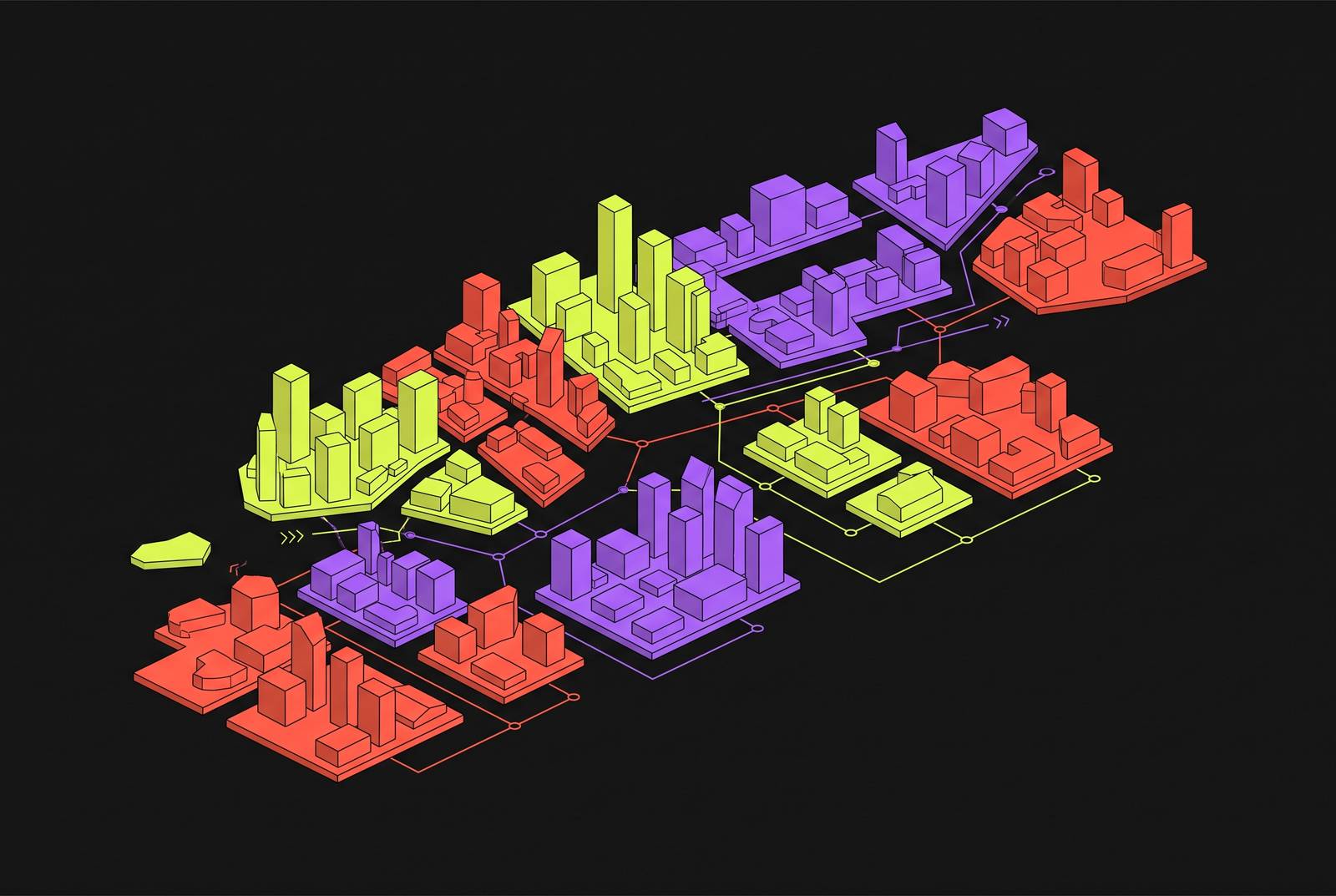
NYC is the second-strongest startup ecosystem in the world, and its defining feature in 2026 is a distributed map of distinct clusters, each shaped by the industries and talent pools that surround it. The old shorthand, Silicon Alley, named a real place once: the stretch of lower Broadway around Flatiron where the first dot-com generation built its companies. That stretch no longer holds the scene by itself. Each wave that followed, fintech, SaaS, healthcare, AI, pushed the map further out across the boroughs, until no single neighborhood could claim to be the center.
What holds the whole map together is proximity to buyers. Enterprise clients, banks, Fortune 500 procurement heads, and startup founders all occupy the same ten-block radius, in a way no other city replicates. That density explains why different sectors settle in different neighborhoods: each cluster forms around whoever its companies need to be near, whether that's a bank's decision-makers, a research community, or a specific pool of engineering talent. An engineer or founder trying to read this ecosystem by picking one neighborhood and hoping to bump into the right people will miss the point. The density assembles on purpose, at recurring events and in specific buildings, then disperses again.
Flatiron and Midtown South as the densest startup corridor in the city
Flatiron and Midtown South remain the default address for companies scaling B2B SaaS, AI infrastructure, and fintech products. Their tenants, enterprise buyers, VCs, and peer companies, are often within walking distance of each other, and that proximity is the mechanism that makes this corridor work. Accelerators, VCs, and enterprise clients clustered within a few blocks compress the feedback loops that matter most for a company moving through Series A to Series C, shortening the distance between a product decision and the customer or investor who reacts to it.
If you're scoping a move, this corridor gives you the highest concentration of well-funded, scaling companies that already have engineering orgs built out. These are the companies most likely to already have a defined team structure and a product already in market, rather than the wildest early bets in the city, which matters a great deal to someone deciding where to spend the next two or three years.
NoMad as the Series B+ headquarter tier one block north
NoMad sits one block north of Flatiron, running from 25th to 30th Streets between Sixth and Madison or Lexington Avenues, and you can think of it as a graduation tier. Companies land here once they've outgrown raw loft space but still want to stay inside Flatiron's gravitational pull. The neighborhood is close enough to share Flatiron's investor and customer density, and distinct enough to command its own rent premium: asking rents run $85 to $110 per square foot, reflecting full-floor, architecturally distinctive inventory that reads differently than a converted loft.
For engineers, that premium tells you something about the company before you even walk in the door. NoMad companies are at or past Series B, so you get more defined compensation bands, clearer equity stakes, and much less founding-level ambiguity than a seed-stage team a few blocks away in SoHo would give you.
SoHo and its concentration of consumer tech, media tech, and AI lab presence
SoHo marks the first real shift in company profile on this map. Its tenant mix has moved toward consumer tech, media tech, and AI research, because focused teams fit the neighborhood's brand identity and smaller floor plates better than scaled enterprise operations do. Premium consumer brands and AI research presence sit comfortably in SoHo's smaller, architecturally distinct spaces in a way that a 200-person enterprise sales floor does not.
What kind of work would you be doing at a SoHo address? You'd build consumer-facing products, do AI research adjacent to a lab presence, or work an early-stage bet where the product thesis is still being worked out in real time. That's a different calculus than Flatiron's scaling infrastructure plays, and it tends to favor engineers who want a hand in shaping the product rather than building out infrastructure for a product that's already defined.
Union Square as the transit crossroads neighborhood with a distinct commercial character
Union Square's startup profile owes more to its role as a transit hub than to any single sector. The same accessibility that drives foot traffic through the square pulls in marketplace, wellness, and edtech companies too, because their customers can arrive from any borough. The Union Square Partnership's 2025 Commercial Market Report puts commercial availability in the neighborhood well below Manhattan's overall rate, and three major buildings, Zero Irving, 200 Park Avenue South, and 860 Broadway, reached full occupancy. That's a neighborhood with real demand behind it, not one coasting on legacy reputation.
If you're an engineer, Union Square sits at the intersection of Manhattan and Brooklyn commutes. It's a practical detail, but it matters if your team is distributed, since engineers live on both sides of the East River and need a meeting point that doesn't force a long trip for either side.
Brooklyn as a scene, not just a cheaper alternative
Brooklyn's startup presence, concentrated in DUMBO and Williamsburg, has stopped being a story about rent savings. The founders who anchored companies there in 2024 and 2025 could have taken space in Flatiron. They chose Brooklyn on purpose, making a deliberate bet on where their teams would actually live and who that choice would attract. That decision differs from cost-cutting, and it is visible in the kind of company that has settled there.
DUMBO is one of three points in the Brooklyn Tech Triangle, alongside Downtown Brooklyn and the Brooklyn Navy Yard, and it now hosts a real concentration of open-source tech and AI research organizations there. That concentration has given the area an intellectual character distinct from Manhattan's enterprise SaaS density, built around a different set of values: open-source credibility and engineering depth over proximity to enterprise buyers.
DUMBO's character as an open-source and AI research node inside the Brooklyn Tech Triangle
DUMBO's position inside the Brooklyn Tech Triangle has drawn a specific kind of organization: one that measures itself on engineering depth and open-source credibility rather than how close it sits to an enterprise buyer's office. Hugging Face, the AI research and open-source model hub, is headquartered at 20 Jay Street in DUMBO, and its presence alone tells you what kind of engineering culture the neighborhood has built around itself.
For engineers interested in ML infrastructure, open-source tooling, or research-adjacent roles, DUMBO's company profile reads meaningfully differently than Flatiron's. The work here skews toward foundational systems, the kind of engineering that underlies a research community, rather than the go-to-market engineering that defines Manhattan's enterprise SaaS corridor.
Williamsburg as the early-stage neighborhood making a deliberate bet on Gen Z engineering talent
Williamsburg's startup growth runs on a specific hiring logic: founders here are optimizing for a particular kind of engineer, someone early in their career, living in North Brooklyn, and more likely to commit deeply to a small team they can walk or bike to. Asking rents run $50 to $65 per square foot, for spaces that tend to be larger and more customizable than equivalent Manhattan product. The waterfront address itself functions as a talent-attraction signal, not just a place to put desks.
For engineers, Williamsburg startups tend to be at seed to early Series A. You get higher equity upside, more architectural ownership over what gets built, and a founding-team culture that's hard to find once a company has scaled past 50 people. It comes at a cost: less institutional structure, and a longer commute for anyone who needs to be in Manhattan for investor meetings.
The secondary hubs that serve specific sectors: Roosevelt Island, Kips Bay, the Navy Yard, and Jersey City
Beyond the six core neighborhoods, a handful of sector-specific nodes round out the map, and if you skip past them, you miss opportunities that matter to a smaller, specific slice of engineers and founders.
Roosevelt Island centers on Cornell Tech, which has become a hub for university-affiliated startups, and it offers a distinct environment if you have academic research roots or a deep-tech bet that needs university infrastructure behind it. Kips Bay has built an emerging concentration in life sciences, which matters if you work at the intersection of biotech and software. The Brooklyn Navy Yard carries an early manufacturing and hardware-adjacent deep tech presence, so it suits you if you're building something physical alongside the software. Governor's Island offers early-stage experimentation space for climate solutions, a niche but genuine part of the map. Jersey City rounds out the list as a real alternative for cost-sensitive early-stage teams: lower commercial and residential costs, paired with PATH train access to Manhattan in well under half an hour. That's not a compromise, it's a deliberate choice for founders who want the NYC network without Manhattan's overhead.
The AI companies actively hiring across these neighborhoods right now
The neighborhood map matters most to engineers because it predicts the kind of work actually on offer, and the AI companies active in NYC right now span a real range of stages, sectors, and technical problems, and they cluster differently across the boroughs. Hebbia builds AI-powered analysis tools for finance and legal work, with its flagship product, Matrix, letting analysts query millions of documents at once. The company is hiring ML Engineers, Software Engineers, and AI Researchers; top-tier VCs back it, and major financial institutions use it. Dataminr runs a real-time AI platform that detects breaking events from public data, hiring Data Scientists and ML Engineers, and counts major newsrooms, large enterprises, and government agencies among its users, making it one of NYC's most established AI scaleups. Runway, the generative AI platform for video and image creation, continues growing its NYC presence to support creator partnerships and product innovation. Modal, a serverless compute platform built for AI and ML workloads, is growing its NYC engineering team to support developer adoption and platform scalability. Hugging Face anchors DUMBO specifically, running its AI research and open-source model hub out of 20 Jay Street. Captions, an AI video-creation platform offering AI avatars, automated editing, and dubbing into nearly 30 languages, rounds out the list of companies actively building and hiring across this map.
The engineering signal behind a company's neighborhood choice
For an engineer weighing opportunities across this map, neighborhood functions as a reliable proxy for what the role will actually require and how the company makes its hiring decisions. If you see a Flatiron or Midtown South address, expect scaling infrastructure and B2B SaaS work, usually at Series A through C, inside a defined engineering org. These companies have already built out hiring processes, so time-to-offer tends to move faster. You get lower equity upside, but you also get a lower risk of role ambiguity once you're in the seat.
A NoMad address shifts that picture toward Series B+ headquarters, with more structured compensation and less architectural ownership over the codebase, a fair trade for engineers who want to build at scale inside a well-resourced team. SoHo signals consumer-facing product work and AI research adjacency, usually inside smaller teams of 20 to 75 people, with more ownership of product direction and higher role ambiguity, so it's often the better fit if you want to help shape the product as well as build it.
DUMBO points toward open-source and ML infrastructure work, inside a Hugging Face-adjacent engineering culture, often with longer commutes under hybrid mandates. If you follow the open-source ML community closely and want to work nearer to research, that's the right address for you. Williamsburg is at seed to early Series A, carries the highest equity upside on this map, and pairs founding-engineer dynamics with proximity to where Brooklyn-based engineers actually live, so it's the right bet if you want architectural ownership and are comfortable with less institutional structure around you.
Read this way, a job listing's location stops being a detail about rent or commute. It's a signal about team size, company stage, and the kind of technical scope on offer, and an engineer who has mapped these clusters in advance can filter opportunities before a single conversation starts.