NYC Robotics and Hardware Startups Hiring Software Engineers
Backend and platform roles offer the clearest entry point for software engineers.
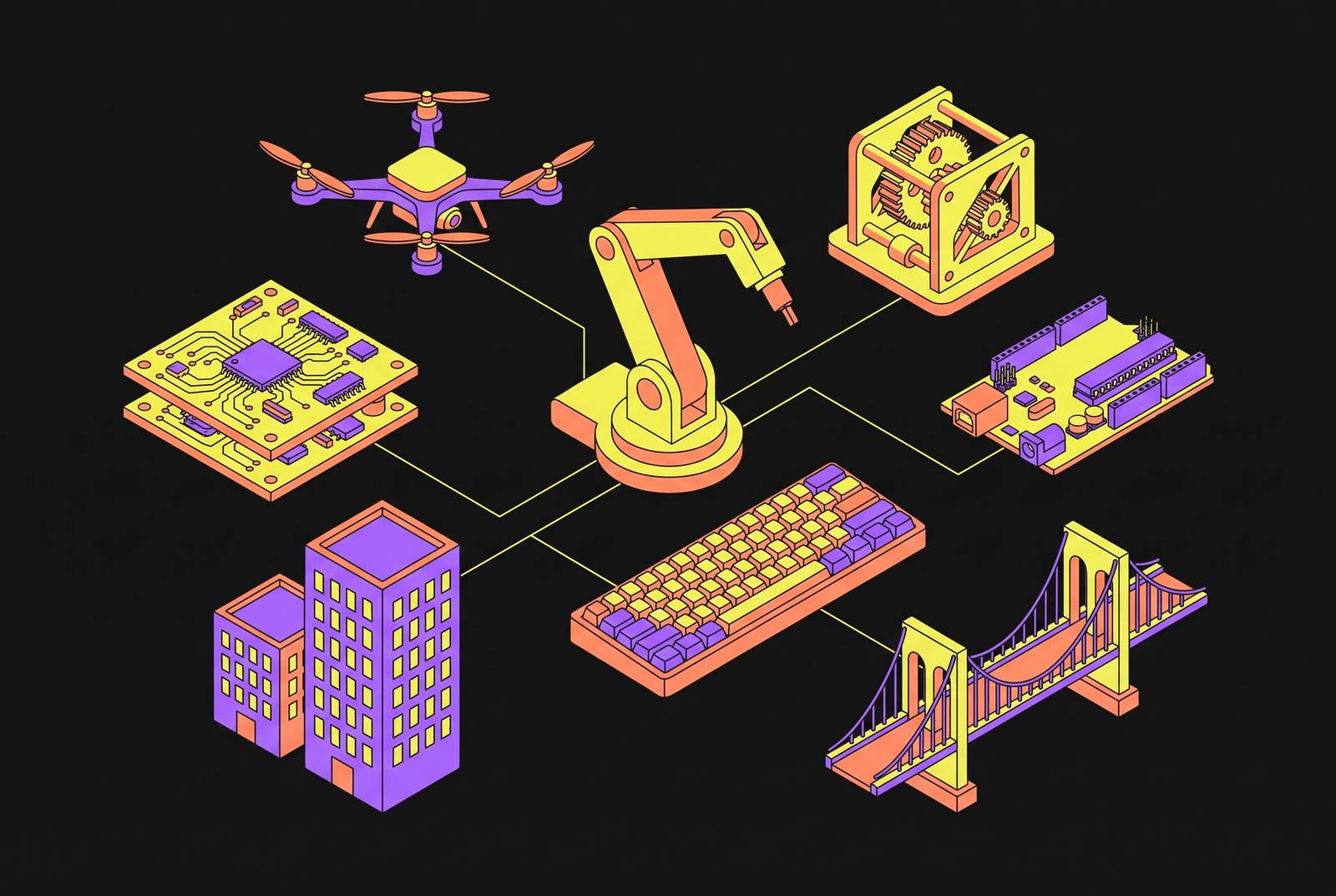
New York City’s robotics and hardware startups are hiring software engineers for jobs that go well beyond controls and embedded work. With many startups in the city alone, this is a serious market for backend, platform, data, and full-stack engineers. The key is to match your software strengths to the right layer of the business, rather than treat every robotics job as the same career change.
Why NYC has become a serious robotics hiring market right now
With the launch of New York Robotics, the city’s robotics industry has a network of its own. NYR’s network spans hundreds of robotics startups worldwide, 80+ industry-leading corporations, 20+ academic institutions, 40+ robotics and embodied AI research labs, and 300+ VC firms actively investing in robotics. Those network-wide figures cover more than companies hiring in New York. They show the reach of the organization connecting the local industry to researchers, customers, and investors.
NYCEDC has backed the sector with access to robotics labs, fabrication tools, and industrial R&D space. Its stated aim is for this technology to be built in New York. NYCEDC cites $2.5B in VC funding to NYC’s robotics and drones sector from 2016–2024.
Why software engineers are the bottleneck these hardware companies most urgently need to fill
A robot is only useful if its software makes it reliable and deployable. For these businesses, the product layer that is hardest to copy increasingly sits in software. Viam makes that argument concrete. Its robotics platform uses standardized software building blocks to solve complicated hardware and software integrations. The product is a software abstraction over hardware.
The hiring needs of other companies point in the same direction. Gecko Robotics builds inspection robots, but its openings at the time of research included data platform and product security work. Mecka AI builds hardware and sensors, but the senior engineer it is hiring will work on backend software. Ultra builds intelligent warehouse robots and needs software-driven automation.
The companies hiring now: what they build, what they're paying, and what stage they're at
At the earliest end, Trace is building data and infrastructure for robotics foundation models with a single-digit headcount. It is at the pre-seed stage, when an engineer joins before there is a large team or a settled way of running engineering. Gambit Robotics offers a more explicit founding-engineer opening. It is building an AI kitchen assistant using computer vision and thermal sensing, and is hiring a Founding Senior Full-Stack Engineer in its NYC office. Neither example comes with a salary figure in the supplied role details.
Reflex Robotics has 19 employees and is building affordable general-purpose robots for boring and repetitive tasks. Its listed opening is in controls, placing it closer to the machine than a conventional backend role. Viam has 74 employees and a more mature software team, with senior and staff backend jobs that follow a NYC hybrid schedule. Mecka AI is at Series B and collects and processes egocentric data for training embodied AI. It recently raised a $60M Series B led by Sequoia, four months after it announced that it had raised $60M in two earlier funding rounds.
Gecko Robotics has 177 employees and builds robots that inspect infrastructure in confined and dangerous environments. Its data platform and product security openings offer distinct paths into the same hardware business. Fauna Robotics (Amazon, NYC) is building capable, safe robots for everyday life and is posting Robotics Software Engineer roles. These employers span small independent teams through an Amazon business, so the company’s stage matters as much as its robot.
What these roles actually require from a software engineer without a robotics background
Backend and platform roles provide the most direct crossover for many software engineers. Mecka AI’s senior backend opening and Viam’s staff backend roles call for Python, distributed systems, and API design. Gecko Robotics’ data platform work centers on SQL, cloud infrastructure, and data pipelines. Gambit’s full-stack opening similarly emphasizes product and systems breadth rather than robotics domain knowledge as the primary requirement.
The on-ramp gets steeper nearer the machine. Treeswift’s Senior Robotics Engineer (Perception) work involves C++, Python, SLAM, sensor fusion, and LiDAR. Reflex Robotics’ controls work and Bedrock Ocean Exploration’s Staff Robotics Engineer role are closer to work on embedded software and hardware-in-the-loop systems. Common signals across the wider set of postings include C++, Python, ROS/ROS2, Linux, Git, systems design, and simulation tools such as Gazebo and MuJoCo. The requirements an applicant must satisfy depend on the role.
Research roles also need to be separated from production engineering. Research Scientist jobs that involve new architectures for physical AI often call for a doctoral degree. ML and Robotics Software Engineer roles instead own production integration across areas including vehicle control, motion planning, localization, perception, and fleet management. The title alone can obscure that distinction. A robotics software engineer may be a software engineer working on robotics systems.
How founding engineer roles at robotics startups differ from mid-stage engineering jobs
A founding role is not simply a mid-stage job with fewer colleagues. The work tends to include designing core infrastructure from scratch, owning systems end-to-end, and shaping engineering culture with the founders. It can also involve shipping AI agents or working directly with customers. Gambit is the clearest example of the opportunity in this group. Its co-founders are Nicole (ex-Google AI) and Eliot Horowitz (co-founder/former CTO of MongoDB), and its founding full-stack hire sits close to both product and systems work.
An initial founder conversation often focuses on what the candidate has shipped and why they want to leave a more stable job. A hands-on build session may follow, through a take-home exercise, live pairing on a real problem, or an eval harness exercise that tests how to measure whether an AI feature helps the user. Early-stage processes tend to run three to four stages, sometimes compressed into one to two weeks. These are general patterns, independent of any stated interview schedule for Gambit.
Remote flexibility depends on which part of the system you own. Engineers need access to the machines for hardware debugging, robot operation, and sensor integration, so office policy is only part of what decides where they work. Of the NYC robotics companies covered here, only 14 are actively hiring people to work remotely. Founding roles usually call for work onsite, while some companies that focus more on software have hybrid jobs.
Data platform, cloud infrastructure, backend, and developer tooling offer the clearest path to flexibility. Embedded and controls roles are much less likely to offer the same freedom because their work is tied to the hardware. The useful distinction is therefore not “robotics versus software.” It is work that needs the machine in reach versus work on the software services around it.
Compensation benchmarks across the NYC robotics stack
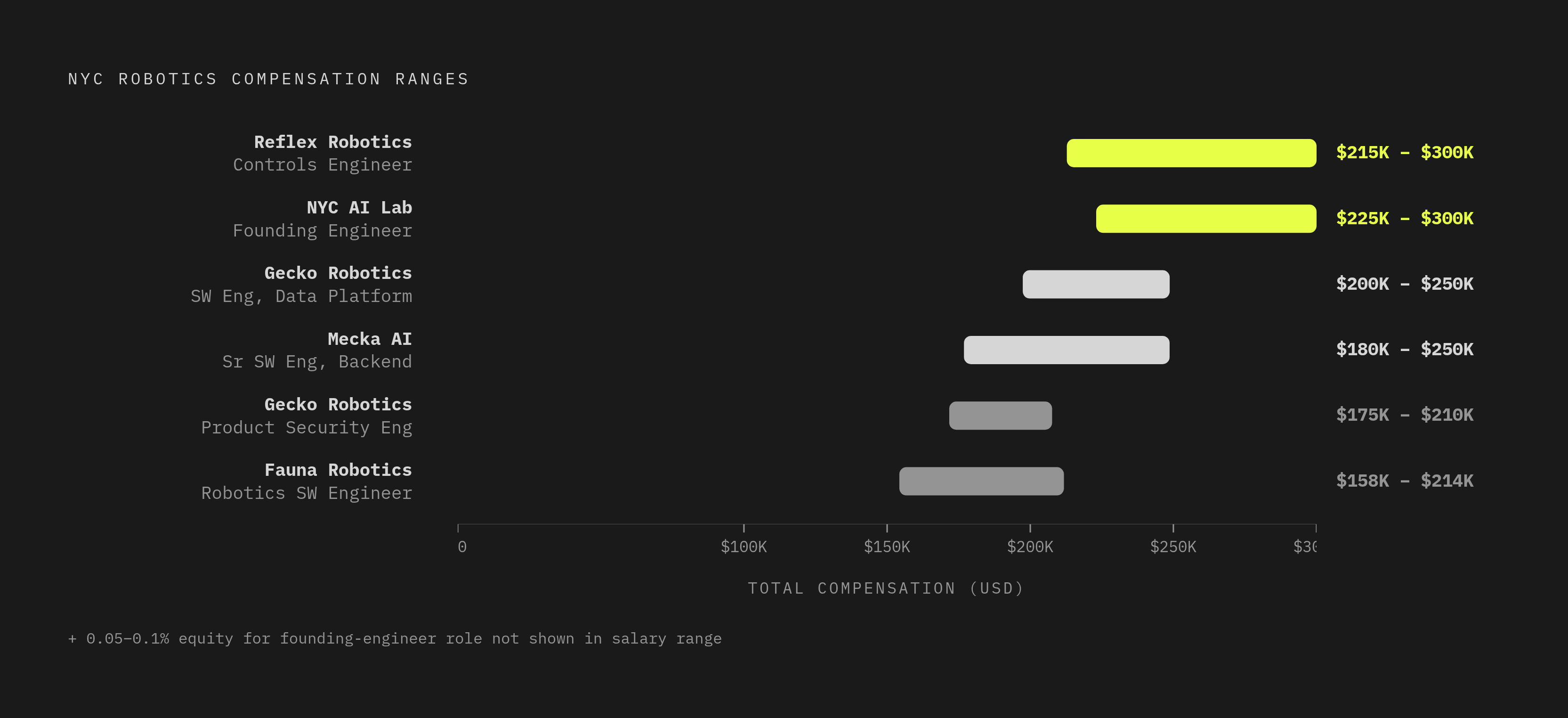
Reflex Robotics posts its Controls Engineer role at $215K–$300K. Gecko Robotics lists Software Engineer, Data Platform at $200K–$250K, while Mecka AI lists Senior Software Engineer (Backend) at $180K–$250K. The pay range for Gecko Robotics’ Product Security Engineer is $175K–$210K. Fauna Robotics gives a pay range of $158K–$214K for Robotics Software Engineers.
At the founding layer, one NYC AI lab posted $225K–$300K total comp plus 0.05–0.1% equity, providing a broader founding-engineer benchmark separate from Gambit’s stated package. Bedrock Ocean Exploration gives a pay range in its Staff Robotics Engineer listing, but the details available here leave out the amount. The same material names Treeswift’s Senior Robotics Engineer (Perception), Raydar’s Staff Hardware Engineer, Robotics Systems & Deployments, and ThoughtForge’s Robotics Software Engineer without numeric pay figures.
The spread reflects employers ranging from pre-seed companies to Amazon subsidiaries, with stage the biggest single compensation variable. Specialization matters too, with Robot Learning Engineers and Computer Vision Engineers reaching higher ceilings at senior and principal levels. NYC’s median robotics engineer pay sits meaningfully above the national average but trails San Francisco and Seattle. That geographic context does not erase the differences between salary ranges, total compensation, and equity.
Where to find these companies and the people who work at them in New York
New York Robotics and New York Tech Alliance co-host the NY Tech Meetup on robotics and embodied AI. Its talks, live demos, and networking bring founders, engineers, and researchers into the same room. The Comma Deeptech Meetup in Manhattan focuses on robotics and physical AI. AI Engineers Tech Talks adds monthly technical deep-dives, with past hosts including Harmonic, Instacart, and Hebbia. These are concrete community entry points before an application reaches a hiring team.
Larger event programs show the breadth of that community. NYC Tech Week ran June 1–7, 2026, with hundreds of events, including a robotics GTM breakfast, a session on building a scalable consumer hardware business, and a NY Hardware Meetup at 55 5th Ave in the Flatiron/Greenwich Village area. NYU hosted a Deep Tech Week event at its new Center for Robotics and Embodied Intelligence in Brooklyn, with 600 registered and hands-on robot demos. Newlab’s headquarters at the Brooklyn Navy Yard gives hardware and deep tech startups a place to gather, with Dock 72 nearby. Flatiron/NoMad is useful for mid-sized startup events, while SoHo/NoLita hosts VC offices and founder dinners.
The one real structural challenge: lab space, manufacturing, and why it hasn't stopped the ecosystem
New York’s hardware constraint is real. Lab space, manufacturing partnerships, and supply chain infrastructure are expensive and logistically difficult in a dense city. Boston has structural advantages through its proximity to MIT and established manufacturing corridors. Capital and software talent do not make those differences disappear.
The local response has been shared infrastructure and institutional support. NYCEDC’s facilities support, Newlab’s hardware development and prototyping space, and NYU’s robotics center give companies ways to build here. Standard Bots, Gecko Robotics, Viam, Ultra, and Mecka AI have raised significant capital and committed to NYC. Their presence shows that the constraint is manageable. For software engineers, it applies much less directly because the roles being filled generally do not require fabrication or supply chain access.
How to position yourself for a move into this space
Start with the role cluster. Backend and platform engineers can target Viam, Mecka AI, and Gecko Robotics’ data platform work. Full-stack engineers with a good feel for what makes a product work can look at founding roles such as Gambit’s. Engineers with C++ and systems experience can reach toward perception and controls work at Treeswift, Bedrock, and Reflex. That targeting keeps the search grounded in what you can contribute now and where the learning curve is genuinely steeper.
Then make that contribution visible through an open-source project, a side build, or a GitHub repo with real systems code. Founders at early-stage companies want to see what you have shipped when your credentials alone tell them too little. Keep your resume current, availability confirmed, and compensation expectations clear so a short process does not catch you unprepared. NY Tech Meetup, Comma Deeptech, and Newlab events offer a route to warm introductions, which move faster than cold applications in this market. The opportunity is not to abandon software for robotics, but to put proven software skills where hardware companies urgently need them.